
ALL POSTS
an infinite scroll archive of all posts
-
look out kid, don’t matter what you did
Ah get born, keep warm
Short pants, romance, learn to dance
Get dressed, get blessed
Try to be a success
Please her, please him, buy gifts
Don’t steal, don’t lift
Twenty years of schoolin’
And they put you on the day shift
Look out kid
They keep it all hid
Better jump down a manhole
Light yourself a candle
Don’t wear sandals
Try to avoid the scandals
Don’t wanna be a bum
You better chew gum
The pump don’t work
’Cause the vandals took the handles–
Bob Dylan. Recorded January 14, 1965. “Subterranean Homesick Blues.” Track 1 on Bringing It All Back Home. Columbia Records of Sony Music Entertainment Inc, March 8, 1965.
It was very early in the morning, the streets clean and deserted, I was on my way to the station. As I checked my watch against the tower clock I realized it was much later than I had thought and that I had to hurry, the shock of this discovery made me feel uncertain of the way, I wasn’t very well acquainted with the town as yet, fortunately there was a policeman nearby, I ran up to him and breathlessly asked him the way. He smiled and said: “You asking me the way” “Yes,” I said, “since I can’t find it myself.” “Give it up! Give it up!” he said, and swung around, like someone who wants to be alone with his laughter.
–
Franz Kafka, “Give it Up!” in The Complete Stories (Schocken Paperback, 1976).
Written between 1917 – 1923 and first published posthumasly in Beschreibung eines Kampfes (1936).
Bob Dylan: Central/Eastern European absurdist?
(I can’t help but think Bob and Franz would have been friends)
room of one’s own
“A woman must have money and a room of her own if she is to write fiction.”
Virginia Woolf, in chapter one of A Room of One’s Own.
First read to the Arts Society and Newharn and the Odtta at Girton in October 1928. Published as an essay by Leonard and Virginia Woolf at the Hogarth Press, London, 1929. Available free online at Project Gutenberg Australia.
I just got home from hearing Tim Snyder speak about his latest book, “On Freedom.” Much more on this soon.
I heated up spinach feta chicken sausages from Lidl, with sauerkraut. Fine cuisine or crafted chef-ery it is not, but it’ll do for a late night and blood sugar levels in need of rapid rectification. Blueberries and chamomile tea to scroll for a minute before tucking myself in for the night. I just washed the blanket on my reading chair and it smells faintly of herbal soap, clean and fresh and warm.
Head is happily full of ideas. Belly is happily full of food. Body is happily held by my bed, in my apartment, in my pajamas. The curtains I sewed from paint store dropcloth flutter in the night breeze and the crickets chirp in the park across the way.
I paid my rent, bought the food, thrifted these pjs, made the curtains, hung the rods, all by myself, for myself. I can walk to bookstores and hear world-renowned historians chat about freedom with a member of congress on a Wednesday. A couple years ago, my college professor told me I should go study under Snyder. It made sense then and it makes sense now. I will, someday, sooner rather than later if I have anything to say about it. I got myself here, so I’ll get myself there, too. And I love it here. I feel like I have a nest now. A place to slowly warm, in safety. To hatch, to fly out of, to come back to.
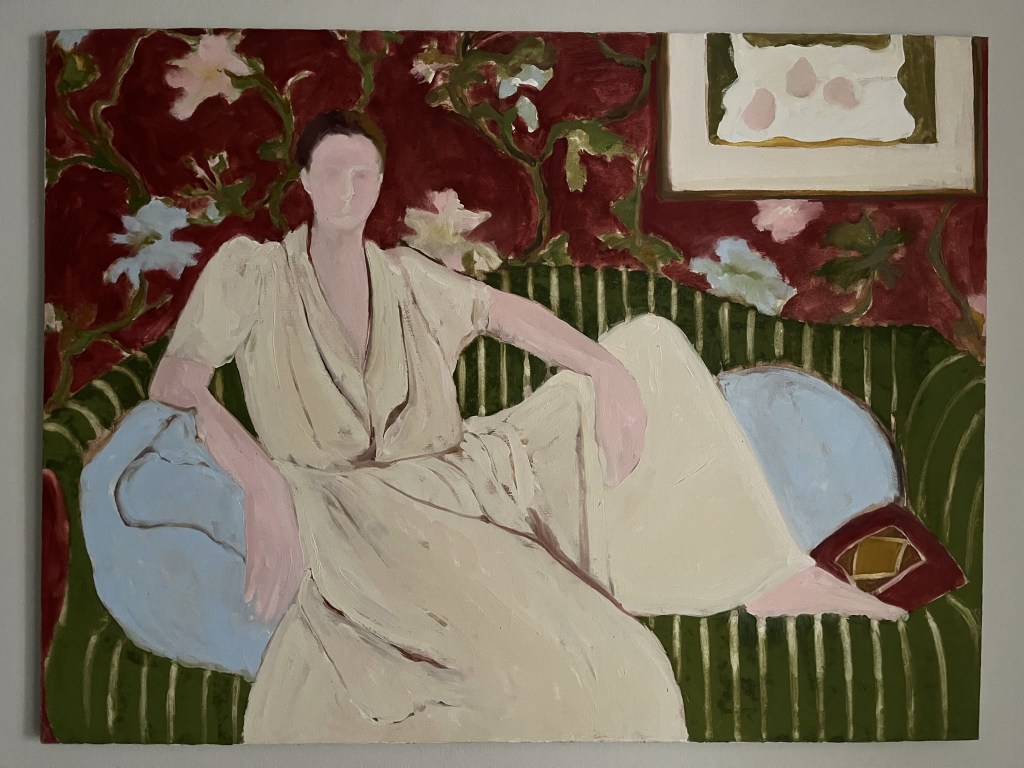
My eyes drift to the large canvas hanging on the wall across from me as these thoughts stir under increasingly heavy lids: My grandmother’s painting of a woman lounging in a tasteful manspread on a green striped sofa.
The painting wasn’t quite finished when my grandmother passed. I found it in my grandparents’ home’s attic last year. I took it without asking. My grandfather and father cling to physical representations of my grandmother with white knuckles and eyes squeezed shut in the effort. Perhaps it’s grief, perhaps bits of something else. I hold on to her too, in my own way. But tight grasping is their right, I suppose. The property is in their name. She never had any property in hers.
So I took it without asking. Smuggled it under a blanket it my car for the six hour drive. It’s been many months, and I haven’t told them. I opted to one day seek forgiveness, not permission. I don’t know how earnestly I’ll seek the forgiveness. Tbd.
But this painting is beautiful, and I doubt they even knew about it. I don’t know if she had a name for it, but I’ve taken to titling it “A Room of Her Own.” It came to me so immediately that it was almost more like the painting titled itself and screamed it at me before I tucked the last corner of blanket for its smuggled journey. The way the woman sits on the sofa is relaxed, confident, commanding, unbothered. It’s her sofa, in her room.
We sit together, in our room. I on my white sofa, she on her green. (side note: never get a white sofa.)
The woman who painted her may never have had a room in her name but I have one in mine. Her name may have been changed to another man’s, well before her frontal lobe was fully developed, but I chose mine. For me, for us.
I’m the first woman in my family to have been born while it was legal for me to have a line of credit in my name. But I also now face a world like the one my grandmother was born into where I do not have the right to make healthcare decisions about my body.
But I have a room of my own. And my grandmother’s painting for constant company. We’ll write here together.
I have a room of my own. And now I have a blog.
shitty chess
chats with a friend

“God navigating partisan political dynamics is like being a helpless child trying to negotiate a compromise between what they need to be able to thrive and *the most unreasonable parental figure who’s giving them nothing*”
Yeah it fucking sucks.
But like being that helpless child it gets better once you realize that a lot of parental figures are actually also just big children, and that, in being a quiet obserant child, you can notice the immovable walls and fuzzy leylines that make up the world, and learn how to walk between them or manipulate them to make a path to the things you need. It’s chess. It just feels shittier than chess because the movable pieces are salient to every part of the human experience.
What’s in a name?
on ‘Four Point Font,” briefly.
excerpted from the ‘about’ page of this site
To introduce Four Point Font, I must first introduce you to my godmother: Ubermensche and universal idol, Jane McAlevey.
She’s not really my godmother. We’re both agnostics, to start. ‘Godmother’ is just the best term to describe the relationship with fewest words: A long-time family friend who isn’t a biologically related aunt/uncle but practically speaking could be one, but one that stands out from the broader Auntie community in how they contribute to the emotional and spiritual rearing of their respective godkiddo. In lieu of any church tradition or religious doctrine, Jane modeled for me a philosophy of life, a value set, and instructions for how to use them every day. Thus, I deemed her my godmother, and we all thought that made sense.
Beyond who she is to me, she is an infinite number of things. A simple google search will begin to impress this upon you.
The phrase “four point font” comes from a book talk she gave in March 2022. It was recorded and released as a podcast episode of The Dig, and I highly recommend a listen to anyone and everyone. The talk is remarkable on its own: intelligent, instructional, broadly intelligible and applicable, incisive, funny, and hopeful. The context of the talk is all the more remarkable.
As the universe is wont to do, it leaves some of the best of us with the least amount of time. She was diagnosed with terminal cancer many years back.
In December 2022, she was given days or weeks to live. Certainly, her doctors said, she wouldn’t make it to spring. She scoffed at this; She was in the middle of writing a book, and something as trivial as certain death would not get in the way of publication.
She finished the book and held a publication party that spring.
The release weekend was a multi-event, celebratory affair. There was an evening book talk under the warm, dim twinkle lights of The Strand Bookstore’s upstairs rare books room, the worn wood floors covered in overlapping bohemian carpets, and every square foot of the carpets covered by the feet of eager listeners.
The next morning, there was another book talk and Q&A panel with labor leaders at the bright community hub that is the People’s Forum in Manhattan. This is the talk that my blog’s moniker comes from.
Later that same day, the Forum was transformed into a dinner party space to hold a private celebration with Jane’s friends and family. Friends and family flocked in to celebrate. They would have, diagnosis or not, because Jane’s a deeply lovable human who makes deep connections with people wherever she’s gone, all over the world. But the prognosis lent a certain urgency to the celebration.
The evening commenced with a mediterranean feast and continued with fun activities (Guess the Size Raffle: a version of guessing how many marbles are in a container, where the correct answers are placed into a raffle for a prize. Instead of marbles, this was a competition to guess which implant size was Jane’s, post-mastectomy, complete with samples laid out on a table) and silly performances (a rewritten tribute to Jane’s labor successes to the tune of a old picketline shanty, as well as a comedic bit of physical humor where one friend reenacted Jane’s many common gesticulations (as she was known to talk with her hands, especially when addressing larger crowds) and another friend narrated with humorous definitions).
As the evening proceeded, it struck me that Jane had organized her own funeral.
It was lighter than a funeral, of course, because Jane was still alive, and in any case, Jane was Jane. But the speeches and tributes and love shared publicly, communally, that would commonly happen at a funeral were all being poured into this evening where Jane herself could witness, hear, and laugh at it all.
During her brother’s tributary remarks, he called the event her “First Annual Not Dead Yet Party.” We all sobbed a laugh at that. And that was the magic of Jane’s presence and outlook: Never shying away from the most difficult parts of life, but facing it all with intentional and abundant joy.
When she passed away this July (2024), it was just over three months after her second annual Not Dead Yet party.
I’ll write lots more about Jane, and about her work, on this site. I think about her every day. Many of her values, ideas, and systems of ideas guide me, whether I think about it or not (though I try to think about it and be intentional about the practice – they’re some damn good ones).
I’m placing her essence in be the foundation of this blog for a number of reasons. In the talk recorded as a podcast, the interviewer, Micah Ulricht, asked her about her values and ideology, her applications of them and her practices:
(This section I’ve excerpted isn’t the shortest, but I think it’s relevant if you’ll bear with me. Below is a transcription; I do highly recommend giving the whole podcast a listen. Jane has one of those voices. I think you’ll enjoy, and get something out of it.)
Micah:
I wanna zoom out for a second and talk about your relationship to ideology because I’m interested in the tactics that you’re describing in the book, practical methods for how to win, but also the sort of bigger picture questions. On the one hand, you don’t seem to have a lot of interest in or patience for ideology. You are principally interested in winning.
I told you about a project I was working on the other day about old socialists who were in the labor movement, many of whom lost quite a bit. And you were kind of like, “Why would you waste your time? All those people, they didn’t win very much, so why would you bother with that?” Which is a fair question.
So you’re interested principally in winning.
On the other hand, especially in No Shortcuts, you go quite a bit into the history of the American labor movement. And you seem to have a very fundamental respect for the organizing that was done by the Communist Party and various kinds of socialists during the heyday of the CIO in the 1930s because there’s a very clear scholarly consensus that these radicals were the most dedicated organizers in that period. You couldn’t have built the early CIO if you didn’t have radicals playing very key roles in such organizing. So, yeah, you seem less interested in people who can sort of cook up impressive theories and more interested in people who can carry out impressive wins. Is this an accurate description?
Jane:
Yes. Is this a trial? (laughs) Yes. Now, I answer yes to the first question. I’m much more interested in people who are teaching people how to win in the immediate. And it’s not that I don’t think ideology doesn’t matter. It’s that I think what matters is: What are the principles on which we’re doing the work? Can we point to them showing success?
And so part of my cynicism about not spending a lot of time on these questions [of ideology] for my whole lifetime, is rooted in several things:
There’s not a lot of great world historic examples to show for in the name of communism or socialism. And there’s definitely not good ones to show from capitalism. I mean, let’s just be super clear.
But if, as an organizer, day to day, what I’m doing is raising people’s expectations that they themselves can build the power to change their workplace and win, then having a long discussion about the debates of what did or didn’t work in the Soviet Union is not actually gonna help the campaign at all. What is gonna help workers come to understand capitalism is a problem is not me telling them that; It’s actually them experiencing the crisis that capitalism is creating in their lives. And so I feel like I do ideology in every campaign and every day of the week. And I do that ideology by helping workers come to the realization that the system in the United States that they’re living under is an absolute abject failure. That condemning people to poverty who make the profits every day is an absolute failed model. And so there must be something better out there. And I’m pretty sure that that’s socialism, right? I mean, if you push me on it. I – you know, the principles of socialism are good, but I’ve met too many people who call themselves socialists who are the biggest assholes who couldn’t win a thing. Two words: Couldn’t win. They are really just ineffective at what they do generally, so I’m not gonna spend a lot of time hanging out with them. It’s not helpful to me and it’s not helpful to the American working class.
When we get close enough to being able to contest for state power, I’m gonna switch gears a lot and focus on that [explicit ideology]. But at this point, we’re trying to teach workers how to control their unions, so that they can go on and actually win and challenge mayors and small-s state power. And in the methods that we’re using is ideology. Transparent, big, open negotiations is ideology. Being honest with workers about what it’s gonna take to win to me is a form of ideology. Showing them, and helping them experience building small d-democractic collective worker majorities that can govern their workplace is like – what is better than teaching workers how to actually govern the hardest place to govern (which is their work life), gaining control of their schedules, and everything else that a good union contract will result in?
So, again, it’s not that I don’t think it matters. It’s that from age 18 or 17 on, when I was a student organizer and some schmuck from the Spartacus League stuck a 4-point-font newsletter in my hand, I just thought, ‘who are these losers?’ Seriously, I didn’t even know what the Spartacus League was. I’m like, are you people from Greece or Rome or like, who are you? (chuckles)
And then at subsequent conferences of explicitly left people, I’d be bombed by, like, 90 other people handing me 40 different versions of a badly put together newsletter that was in 4 point font yelling at me. I just thought, I’m just not spending my time with these people.
Now that doesn’t count, Jacobin, and that’s why I’m here. And I’m totally serious.
Micah:
Well, and it doesn’t count, as I said, the communist party in the auto factories, and…
Jane:
Absolutely. Absolutely. And by the way, not only does it not count them, oh my god, of course they get credit. I mean, I do give the communist and socialist credit in their shortcuts. There’s an entire chapter on it, right? And I and what I do is show what they were doing. And art of the point of what they were doing is no different than what I’m doing. I tried to argue that whether the experienced, skilled organizer is positioned inside the workplace, in the rank and file, or outside, like I have been, doesn’t matter.
What matters is: What are we teaching the workers? How are they learning it? And are they learning self confidence, and the ability to win?
And I absolutely believe capitalism is an absolutely failed model. There’s no question about it. I just don’t spend a lot of time, like, what’s what’s gotta be perfect about the new system? Because we’re so far from it. And, honestly, when we get closer, I’m ready to throw down and figure out what it is.
Micah:
Well, this, leads to the, point that you make in the conclusion of your previous book, A Collective Bargain, and you make several other times in your work that while you’re mostly writing about strategy and tactics for organizing unions and negotiations, you take pains to say that the strategy and tactics that you’re laying out are not just about the labor movement, and, in fact, should be used as part of a broader transformative project in all of society that can include politics, that can include other kinds of social movements. Can you talk briefly about the potential for the use of these kinds of strategies that you lay out in these books as going beyond the labor movement?
Jane:
Definitely.
And I actually do wanna just say, I love The Dig and Jacobin, and there’s a whole group of socialists who I know who are doing work that I actually think is important. I mean, I was just razzing there for a little bit, which I think was also deserved, to a lot of them. [laughs]
I do think The Dig is one of the more intelligent things I get to listen to when I’m riding my bike or working out.
But anyway, I think that the methods apply across the board, and the handful of concepts which are:
That there are what we call organic or natural leaders that exist, all through society;
The organizer doesn’t make leaders, leaders actually exist. Our job as organizers is to help coworkers – or tenants, if they’re building a tenant union, or students, if they’re trying to build Fridays for the future to save the planet, in their K through 12 education system – identify that there are natural leaders among the working class all over the place.
And that we’re gonna be more effective if we help lead with people who are already natural leaders, who will then need to be skilled up and taught the art of war, essentially, which is sort of what these methods are. And that doesn’t just exist in the workplace.
So, we do something called ‘whole worker organizing.’ That’s just the word I gave it, but it’s what the communists and the socialists were doing. It was the extension of the work to bring the workers’ own community into the fight.
People will say to me oftentimes – only in academia, not workers, but in academic debates or debates with socialists – they’ll be like, yeah, you can’t really do that anymore though because people don’t go to church, or they don’t have any more faith, or people are dispersed or they don’t live together. It isn’t like factories like the 1930s & 40s where you had huge populations of immigrants living next to each other in a factory town, and so of course the whole community came out to support them. Sorry, do I sound cynical? I’ve heard this so many times. Whole worker organizing is a method to show that it takes a little bit more work these days:
We have to adjust that idea for the times.
(We don’t in in some places by the way, like in meatpacking factories – there are exceptions to this.)
There are different conditions in 2023 than there were in 1933.
So how do you adjust for them?
Whether it’s across decades and centuries or across workplace, non workplace into building a tenant union or building a more effective climate justice movement. The methods of identifying natural leaders and then helping skill those people up to lead whatever it is, whatever the fight they’re having is, to lead that struggle. That is gonna be more effective and efficient ultimately than just spending all of our time talking to the most committed people who come back to every meeting every day.
We’re just not gonna win by talking to ourselves.
We are gonna win when we train people across movements and across sectors to realize that there’s a set of methods, and, you know, they’re not fixed. They’re called methods and not models for a reason. Methods are adjustable, and we adjust them to different times and conditions and settings. But the methods matter.
And a core one is:
Stop talking to just yourselves, and start spending every single day talking to people who you’re not talking to, because that’s the way we’re gonna build the kind of power required to stop fascism.
So I’ve started a blog called Four Point Font. It’s a badly put together publication of minutiae. It’s a ramshackle place for musings big and small, for plunging into deep thought, theory, and wells of ideas so niche they might be inane. It’s me talking to myself. But the hope is that the practice of writing will help be 1) clarify my own thinking, and 2) communicate clearly when go back out into “the world.” I promise not to accost anyone with printouts or force any of my shmuckery down anyone’s throat.
The name is both serious and tongue-in-cheek.
There’s a part of me that finds any publication of individual thoughts, or public generation of the personal, to be rather indulgent. Thus, I have adopted Jane’s adjectives to mock myself in this whole enterprise.
There’s a serious component to this name, too: The title of my Thinking Place is a reminder that only thought by itself is not The Work. That’s pretty well reserved for the physical world, not the digital. The Work is what’s most important, and the title will hopefully poke me away from the Camusian pitfall of abandoning humanity in favor of ideas.
But thinking and writing and, most importantly, reading, is a small part of The Work, and this will be my dedicated place of practice. I will do my utmost to keep joy and hope as the beating heart of this space so that this pulse is felt in every phrase, like the loving godchild of Jane that I am.
I have no idea if there is an afterlife, or what it could possibly be, or how we could possibly get there. The only afterlife that is certain is the imprint we leave on those around us while we are here on this earth in the time we’ve been given. There is afterlife in what we leave behind. This afterlife is in the hands of those who hold our imprints.
Long after our pulses have stilled, I truly hope that the echos of that rhythm are ones of joy and hope and love. I hope that those rhythms keep their tempo without pause in the pulses of others. Jane’s spirit echos ebulliently, and the joyous rhythmic vibrations she’s generated are ones that I have gladly, gratefully, intentionally tried to match and integrate into my every vein. She worked to make present life more heavenly. I, too, find that to be a more worthwhile use of our limited focus, energy, and time, than concern with a legacy or destination for a soul once it’s parted from my body.
Thus, this blog will be indulgent (obviously), but not strictly memorial, and it will be above all unerringly dedicated to people and the present, to joy, to love, to fun, and to our collective wellbeing and liberation. Hope will be taken seriously. Egos will not be. This includes my own, and its frustratingly tight grip on perfectionism. Grace will be given endlessly. Exploration will be messy and deeply imperfect. Learning will be a journey equally so. And, if nothing else, it will be.
So this is Four Point Font. I’m thrilled to be here, and I love you.
hannah & francesca
some quick thoughts on the Times article-spurred Ballerina Farm Discourse, Francesca by Hozier, and of course Dante.
If Hannah Neeleman, Ballerina Farm, doesn’t make it to Heaven, perhaps she’ll float in the second circle with Francesca and Paulo. Daniel won’t be there; his sins are deeper. Souls find themselves in the great whirlwind of The Carnal, this second circle, having allowed a certain other whirlwind to sweep them away in life. “Their sin was to abandon themselves…”1
The fuller passage reads:
The Poets leave Limbo and enter the SECOND CIRCLE. Here begin the torments of Hell proper, and here, blocking the way, sits MINOS, the dread and semi-bestial judge of the damned who assigns to each soul its eternal torment. He orders the Poets back; but Virgil silences him as he earlier silenced Charon, and the Poets move on.
They find themselves on a dark ledge swept by a great whirlwind, which spins within it the souls of the CARNAL, those who betrayed reason to their appetites. Their sin was to abandon themselves to the tempest of their passions: so they are swept for forever in the tempest of Hell, forever denied the light or reason and of God.”2
Francesca and her lover, Paulo, swirl in this Circle. In life, they were married to others but had an affair with one another. In death, Dante writes them enduring eternal punishment for their adultery, together. Their affair was abandonment of reason in favor of passion. When Francesca describes the events that landed her in this Circle, she describes being “seized” by love, that “Love led us [Francesca and Paulo] to one death.”3 She portrays herself with the passive voice; she negates her own agency.
I don’t particularly subscribe to the same marital sanctity standards as the Christian tradition on which Inferno is based, so I actually have quite a bit of sympathy for Francesca and Paulo whose love was sinful because it went against the Church-sanctioned marriages that they were in (politically-arranged ones, if historical records hold any truth). Dante Alighieri seems to have sympathy for the pair, too, in his depiction. His implicit critique is not that the sin was in extramarital love, but rather in denial of ones own agency. That is, abandoning oneself to the tempest of one’s passions is perhaps not the sin as much as is abandoning oneself, full stop. Abandoning yourself, perhaps, goes deeper; It is not against God directly, but against yourself.If you’re into the God thing, then abandoning yourself, God’s creation, is to abandon God. If you’re not into the God thing, the point stands.
It’s not Hannah’s fault, purely. Powerful forces of manipulation went to work, against which she had little chance. But she’s found herself abandoned by her own self, and is in a whirlwind here on earth. The rest of us watch her, as Dante and Virgil did Francesca, from the dark ledge, a bit of glass and some pixels separating us from where she floats, spinning and swirling like the stormwinds, spinning and swirling like a ballerina, cuffed to the spirals by the wind.
“Now that it’s done
There’s not one thing that I would change.
My life was a storm since I was born
How could I fear any hurricane?
If someone asked me at the end
I’d tell them, ‘Put me back in it,’ darlin’
I would do it again.”4
Hozier’s response is in the active voice.
Would hers be?
Would she do it again?
hope and scope
Does hopelessness come from having knowledge that extends beyond our scope of influence?
-
windows
Whoever leads a solitary life and yet now and then wants to attach himself somewhere, whoever, according to changes in the time of day, the weather, the state of his business, and the like, suddenly wishes to see any arm at all to which he might cling–he will not be able to manage for long without a window looking on to the street. And if he is in the mood of not desiring anything and only goes to his window sill a tired man, with eyes turning from his public to heaven and back again, not wanting to look out and having thrown his head up a little, even then the horses below will draw him down into their train of wagons and tumult, and so at last into the human harmony.
–
Franz Kafka, “The Street Window.” Translated by Willa and Edwin Muir in The Complete Stories (Schocken Paperback 1976). First published 1912.
Does it feel alright to not know me?
I’m addicted to the ‘if only’
So I look in people’s windows
Like I’m some deranged weirdo
I attend Christmas parties from outside
I look in people’s windows
In case you’re at their table
What if your eyes looked up and met mine
One more time
–
Taylor Swift, “I Look in People’s Windows.” Track 25 on The Tortured Poets Department: The Anthology. Released April 19, 2024.
Inside, outside.
Any arm, a specific arm.
Attachment of wholes, completion to a whole.
Harmony, melody.
What do we keep out with panes of glass?
What do we let be seen through the glass?
Thinking.
-
 Four Point Font